Compare with jaxoplanet#
Since squishyplanet takes a more numerical approach to generating transit lightcurves than elegant packages such as exoplanet and starry, it had to trade either speed or accuracy in exchange for the ability to model more complex planet shapes. We’ve opted to sacrifice the former to preserve the latter. So, in the limiting case where squishyplanet models a truly spherical planet, we want to make sure that it agrees with previous implementations of the polynomial limb darkening
model.
Here we’ll compare the performance of squishyplanet with jaxoplanet, a JAX-based implementation of the exoplanet and starry packages.
[1]:
# JAX imports
import jax

jax.config.update("jax_enable_x64", True)
import jax.numpy as jnp

# Helpful misc imports
import matplotlib.pyplot as plt
from jaxoplanet.light_curves import limb_dark_light_curve

# jaxoplanet imports
from jaxoplanet.orbits.keplerian import Central, System
from jaxoplanet.units import unit_registry as ureg
from tqdm import tqdm

# squishyplanet imports
from squishyplanet import OblateSystem
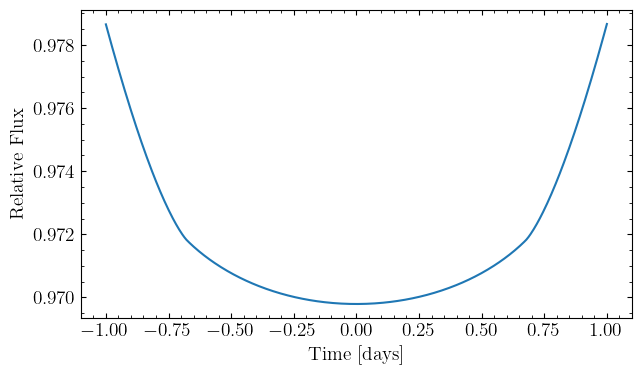
Let’s first generate a random system with quadratic limb darkening coefficients and compare the lightcurves generated by the two packages. We have to jump through a few hoops to directly compare the two since jaxoplanet uses inputs with units, while squishyplanet is scale-free (aside from time units, all distance units are in terms of \(R_\odot\)). Here’s the jaxoplanet lightcurve:
[2]:
poly_limbdark_order = 2
times = (
    jnp.linspace(-1, 1, int(2 * 24 * 60 / 6)) * ureg.day
)  # 2 days at 10 minute cadence
key = jax.random.PRNGKey(0)
key, *subkeys = jax.random.split(key, num=8)

u = jax.random.uniform(subkeys[6], shape=(poly_limbdark_order,))
star_mass = jax.random.uniform(subkeys[0], minval=0.1, maxval=1.5) * ureg.M_sun
semimajor_axis = jax.random.uniform(subkeys[1], minval=0.005, maxval=5.0) * ureg.au
impact_param = jax.random.uniform(subkeys[2], minval=0.0, maxval=1.0)
planet_rad = jax.random.uniform(subkeys[3], minval=0.001, maxval=0.25) * ureg.R_sun
eccentricity = jax.random.uniform(subkeys[4], minval=0.0, maxval=0.9)
omega = jax.random.uniform(subkeys[5], minval=0.0, maxval=2 * jnp.pi)
Omega = jnp.pi

star = Central(radius=1 * ureg.R_sun, mass=star_mass)
planet = (
    System(star)
    .add_body(
        time_transit=0.0,
        semimajor=semimajor_axis,
        impact_param=impact_param,
        radius=planet_rad,
        eccentricity=eccentricity,
        omega_peri=omega * ureg.rad,
        asc_node=Omega * ureg.rad,
        mass=0.0,
    )
    .bodies[0]
)

jaxoplanet_lc = 1 + limb_dark_light_curve(planet, u)(times)

fig, ax = plt.subplots()
ax.plot(times, jaxoplanet_lc)
ax.set(xlabel="Time [days]", ylabel="Relative Flux");
/Users/cassese/Documents/Work/Code/squishyplanet/.venv/lib/python3.13/site-packages/matplotlib/cbook.py:1355: UserWarning: The unit of a Quantity is stripped when downcasted to an array.
  return np.asarray(x, float)
And here’s the squishyplanet lightcurve:
[3]:
# squishyplanet expects angles between 0 and 2pi
Omega = jnp.arctan2(
    planet.sin_asc_node.to(ureg.radian).magnitude,
    planet.cos_asc_node.to(ureg.radian).magnitude,
)
Omega = jnp.where(Omega < 0, Omega + 2 * jnp.pi, Omega)

omega = jnp.arctan2(
    planet.sin_omega_peri.to(ureg.radian).magnitude,
    planet.cos_omega_peri.to(ureg.radian).magnitude,
)
omega = jnp.where(omega < 0, omega + 2 * jnp.pi, omega)

state = {
    "t_peri": planet.time_peri.to(ureg.day).magnitude,
    "times": times.to(ureg.day).magnitude,
    "period": planet.period.to(ureg.day).magnitude,
    "a": planet.semimajor.to(ureg.R_sun).magnitude,
    "e": planet.eccentricity.to(ureg.dimensionless).magnitude,
    "i": planet.inclination.to(ureg.radian).magnitude,
    "Omega": Omega,
    "omega": omega,
    "f1": 0.0,  # this is a perfectly spherical planet for comparison, so f1 = f2 = 0
    "f2": 0.0,
    "r": planet.radius.to(ureg.R_sun).magnitude,
    "obliq": 0.0,
    "prec": 0.0,
    "ld_u_coeffs": jnp.array(u),
    "tidally_locked": False,
}

s = OblateSystem(**state)

squishyplanet_lc = s.lightcurve()

fig, ax = plt.subplots()
ax.plot(times, squishyplanet_lc)
ax.set(xlabel="Time [days]", ylabel="Relative Flux");
/Users/cassese/Documents/Work/Code/squishyplanet/.venv/lib/python3.13/site-packages/matplotlib/cbook.py:1355: UserWarning: The unit of a Quantity is stripped when downcasted to an array.
  return np.asarray(x, float)

They qualitatively seem very similar. To access the accuracy of each, let’s use jaxoplanet to compute a high-precision lightcurve that uses a higher order numerical integrator than the default settings to compare the two.
[4]:
comparison_lc = 1 + limb_dark_light_curve(planet, u, order=100)(times)

fig, ax = plt.subplots()
ax.plot(times.magnitude, jaxoplanet_lc - comparison_lc, label="jaxoplanet")
ax.plot(times.magnitude, squishyplanet_lc - comparison_lc, label="squishyplanet")
ax.set(xlabel="Time [days]", ylabel="Relative Flux")
ax.legend()
[4]:
<matplotlib.legend.Legend at 0x11f2d9550>
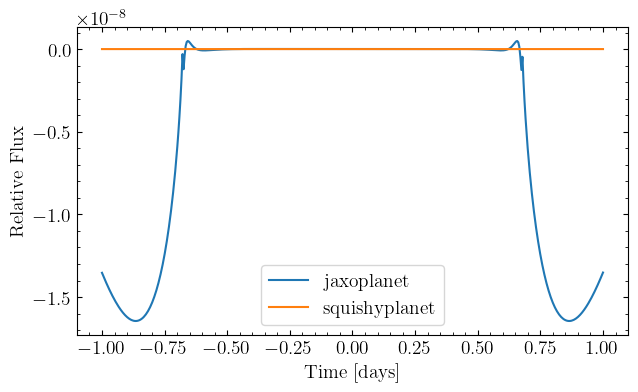
For this random set of parameters at least, both agree with the high-precision lightcurve to within a few parts per billion, meaning they are effectively equivalent for all real-world purposes. Even the highest-quality photometry is typically only accurate to a few parts per million, so although technically here squishyplanet’s default settings produced a more “accurate” lightcurve than jaxoplanet’s, it really doesn’t matter once you’re at this level of precision.
Here is how squishyplanet compares to jaxoplanet as you increase the order term in jaxoplanet’s numerical integrator:
[5]:
fig, ax = plt.subplots()
for order in jnp.arange(1, 30, 4):
    j = 1 + limb_dark_light_curve(planet, u, order=int(order))(times)
    ax.plot(times.magnitude, jnp.abs(j - squishyplanet_lc), label=f"order={order}")
ax.set(xlabel="Time [days]", ylabel="Flux Error", yscale="log", xlim=(-2, 1.2))
ax.legend()
[5]:
<matplotlib.legend.Legend at 0x12134a490>

It looks like around order=20, the difference spikes during ingress and egress reach the same magnitude as squishyplanet’s typical error.
In general, squishyplanet will be slower than jaxoplanet due to a higher reliance on numerical integrals. The difference isn’t huge for a relatively sparse, low-cadence time series like this, but can grow quite large for dense observations. Consider the simple timing experiment:
[6]:
%timeit limb_dark_light_curve(planet, u)(times).block_until_ready()
%timeit s.lightcurve().block_until_ready()
5.48 ms ± 286 μs per loop (mean ± std. dev. of 7 runs, 100 loops each)
3.73 ms ± 176 μs per loop (mean ± std. dev. of 7 runs, 100 loops each)
Now we can compute a more ambitious time series:
[7]:
times = jnp.linspace(-1, 1, 17280) * ureg.day  # 10s cadence for 48 hours
_ = limb_dark_light_curve(planet, u)(times)  # let jax compile the function
state["times"] = times.to(ureg.day).magnitude
s = OblateSystem(**state)
_ = s.lightcurve()  # let jax compile the function

%timeit limb_dark_light_curve(planet, u)(times).block_until_ready()
%timeit s.lightcurve().block_until_ready()
7.36 ms ± 69.3 μs per loop (mean ± std. dev. of 7 runs, 100 loops each)
122 ms ± 1.96 ms per loop (mean ± std. dev. of 7 runs, 10 loops each)
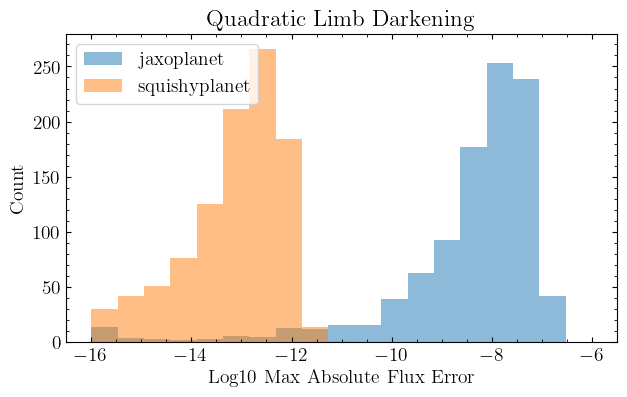
Finally, to make sure that this randomly generated curve isn’t a fluke, let’s repeat the experiment with a few different random systems:
[8]:
def light_curve_compare(key, poly_limbdark_order):
    times = (
        jnp.linspace(-1, 1, int(2 * 24 * 60 / 6)) * ureg.day
    )  # 2 days at 10 minute cadence

    key, *rand_key = jax.random.split(key, num=8)

    u = jax.random.uniform(rand_key[6], shape=(poly_limbdark_order,))
    star_mass = jax.random.uniform(rand_key[0], minval=0.1, maxval=1.5) * ureg.M_sun
    semimajor_axis = jax.random.uniform(rand_key[1], minval=0.005, maxval=5.0) * ureg.au
    impact_param = jax.random.uniform(rand_key[2], minval=0.0, maxval=1.0)
    planet_rad = jax.random.uniform(rand_key[3], minval=0.001, maxval=0.25) * ureg.R_sun
    eccentricity = jax.random.uniform(rand_key[4], minval=0.0, maxval=0.9)
    omega = jax.random.uniform(rand_key[5], minval=0.0, maxval=2 * jnp.pi)
    Omega = jnp.pi

    star = Central(radius=1 * ureg.R_sun, mass=star_mass)
    planet = (
        System(star)
        .add_body(
            time_transit=0.0,
            semimajor=semimajor_axis,
            impact_param=impact_param,
            radius=planet_rad,
            eccentricity=eccentricity,
            omega_peri=omega * ureg.rad,
            asc_node=Omega * ureg.rad,
            mass=0.0,
        )
        .bodies[0]
    )

    compare_lc = 1 + limb_dark_light_curve(planet, u, order=100)(times)
    jaxoplanet_lc = 1 + limb_dark_light_curve(planet, u)(times)

    # generate comparison light curve
    Omega = jnp.arctan2(
        planet.sin_asc_node.to(ureg.radian).magnitude,
        planet.cos_asc_node.to(ureg.radian).magnitude,
    )
    Omega = jnp.where(Omega < 0, Omega + 2 * jnp.pi, Omega)

    omega = jnp.arctan2(
        planet.sin_omega_peri.to(ureg.radian).magnitude,
        planet.cos_omega_peri.to(ureg.radian).magnitude,
    )
    omega = jnp.where(omega < 0, omega + 2 * jnp.pi, omega)

    state = {
        "t_peri": planet.time_peri.to(ureg.day).magnitude,
        "times": times.to(ureg.day).magnitude,
        "period": planet.period.to(ureg.day).magnitude,
        "a": planet.semimajor.to(ureg.R_sun).magnitude,
        "e": planet.eccentricity.to(ureg.dimensionless).magnitude,
        "i": planet.inclination.to(ureg.radian).magnitude,
        "Omega": Omega,
        "omega": omega,
        "f1": 0.0,  # always circular for testing
        "f2": 0.0,
        "r": planet.radius.to(ureg.R_sun).magnitude,
        "obliq": 0.0,
        "prec": 0.0,
        "ld_u_coeffs": jnp.array(u),
        "tidally_locked": False,
    }

    s = OblateSystem(**state)
    test_lc = s.lightcurve()

    m = (jaxoplanet_lc != 0) | (test_lc != 0)
    return (
        jnp.max(jnp.abs(jaxoplanet_lc[m] - compare_lc[m])),
        jnp.max(jnp.abs(test_lc[m] - compare_lc[m])),
    )


jaxoplanet_errs = []
squishyplanet_errs = []
for i in tqdm(range(1_000)):
    jax.random.PRNGKey(i)
    j, s = light_curve_compare(jax.random.PRNGKey(i), 2)
    jaxoplanet_errs.append(j)
    squishyplanet_errs.append(s)
jaxoplanet_errs = jnp.array(jaxoplanet_errs)
squishyplanet_errs = jnp.array(squishyplanet_errs)


fig, ax = plt.subplots()
j = jnp.log10(jaxoplanet_errs)
j = jnp.where(jnp.abs(j) == jnp.inf, jnp.nan, j)
s = jnp.log10(squishyplanet_errs)
s = jnp.where(jnp.abs(s) == jnp.inf, jnp.nan, s)
ax.hist(j, bins=jnp.linspace(-16, -6, 20), alpha=0.5, label="jaxoplanet")
ax.hist(s, bins=jnp.linspace(-16, -6, 20), alpha=0.5, label="squishyplanet")
ax.set(
    xlabel="Log10 Max Absolute Flux Error",
    ylabel="Count",
    title="Quadratic Limb Darkening",
)
ax.legend();
100%|██████████| 1000/1000 [04:47<00:00, 3.47it/s]
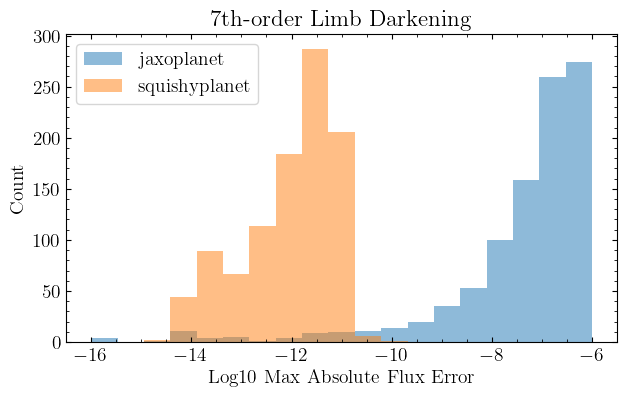
And, to check higher-order limb darkening laws:
[9]:
def light_curve_compare(key, poly_limbdark_order):
    times = (
        jnp.linspace(-1, 1, int(2 * 24 * 60 / 6)) * ureg.day
    )  # 2 days at 10 minute cadence

    key, *rand_key = jax.random.split(key, num=8)

    u = jax.random.uniform(rand_key[6], shape=(poly_limbdark_order,))
    star_mass = jax.random.uniform(rand_key[0], minval=0.1, maxval=1.5) * ureg.M_sun
    semimajor_axis = jax.random.uniform(rand_key[1], minval=0.005, maxval=5.0) * ureg.au
    impact_param = jax.random.uniform(rand_key[2], minval=0.0, maxval=1.0)
    planet_rad = jax.random.uniform(rand_key[3], minval=0.001, maxval=0.25) * ureg.R_sun
    eccentricity = jax.random.uniform(rand_key[4], minval=0.0, maxval=0.9)
    omega = jax.random.uniform(rand_key[5], minval=0.0, maxval=2 * jnp.pi)
    Omega = jnp.pi

    star = Central(radius=1 * ureg.R_sun, mass=star_mass)
    planet = (
        System(star)
        .add_body(
            time_transit=0.0,
            semimajor=semimajor_axis,
            impact_param=impact_param,
            radius=planet_rad,
            eccentricity=eccentricity,
            omega_peri=omega * ureg.rad,
            asc_node=Omega * ureg.rad,
            mass=0.0,
        )
        .bodies[0]
    )

    compare_lc = 1 + limb_dark_light_curve(planet, u, order=100)(times)
    jaxoplanet_lc = 1 + limb_dark_light_curve(planet, u)(times)

    # generate comparison light curve
    Omega = jnp.arctan2(
        planet.sin_asc_node.to(ureg.radian).magnitude,
        planet.cos_asc_node.to(ureg.radian).magnitude,
    )
    Omega = jnp.where(Omega < 0, Omega + 2 * jnp.pi, Omega)

    omega = jnp.arctan2(
        planet.sin_omega_peri.to(ureg.radian).magnitude,
        planet.cos_omega_peri.to(ureg.radian).magnitude,
    )
    omega = jnp.where(omega < 0, omega + 2 * jnp.pi, omega)

    state = {
        "t_peri": planet.time_peri.to(ureg.day).magnitude,
        "times": times.to(ureg.day).magnitude,
        "period": planet.period.to(ureg.day).magnitude,
        "a": planet.semimajor.to(ureg.R_sun).magnitude,
        "e": planet.eccentricity.to(ureg.dimensionless).magnitude,
        "i": planet.inclination.to(ureg.radian).magnitude,
        "Omega": Omega,
        "omega": omega,
        "f1": 0.0,  # always circular for testing
        "f2": 0.0,
        "r": planet.radius.to(ureg.R_sun).magnitude,
        "obliq": 0.0,
        "prec": 0.0,
        "ld_u_coeffs": jnp.array(u),
        "tidally_locked": False,
    }

    s = OblateSystem(**state)
    test_lc = s.lightcurve()

    m = (jaxoplanet_lc != 0) | (test_lc != 0)
    return (
        jnp.max(jnp.abs(jaxoplanet_lc[m] - compare_lc[m])),
        jnp.max(jnp.abs(test_lc[m] - compare_lc[m])),
    )


jaxoplanet_errs = []
squishyplanet_errs = []
for i in tqdm(range(1_000)):
    jax.random.PRNGKey(i)
    j, s = light_curve_compare(jax.random.PRNGKey(i), 7)
    jaxoplanet_errs.append(j)
    squishyplanet_errs.append(s)
jaxoplanet_errs = jnp.array(jaxoplanet_errs)
squishyplanet_errs = jnp.array(squishyplanet_errs)


fig, ax = plt.subplots()
j = jnp.log10(jaxoplanet_errs)
j = jnp.where(jnp.abs(j) == jnp.inf, jnp.nan, j)
s = jnp.log10(squishyplanet_errs)
s = jnp.where(jnp.abs(s) == jnp.inf, jnp.nan, s)
ax.hist(j, bins=jnp.linspace(-16, -6, 20), alpha=0.5, label="jaxoplanet")
ax.hist(s, bins=jnp.linspace(-16, -6, 20), alpha=0.5, label="squishyplanet")
ax.set(
    xlabel="Log10 Max Absolute Flux Error",
    ylabel="Count",
    title="7th-order Limb Darkening",
)
ax.legend()
100%|██████████| 1000/1000 [04:51<00:00, 3.43it/s]
[9]:
<matplotlib.legend.Legend at 0x125921950>